















Short answer. GFRP rebar is made on a continuous pultrusion line: glass rovings pass through a resin bath, a forming die and a cure zone, get a surface treatment for bond, then are pulled and cut. Quality is checked by tests on glass content, cure and tensile properties.
| Stage | What happens | What can go wrong |
|---|---|---|
| 1. Rovings | Continuous glass rovings are fed from a creel in the number needed for the bar diameter | Wrong fibre count changes strength and diameter |
| 2. Resin | Rovings are wetted in a resin bath or injection box (vinyl ester is common for rebar) | Dry fibre or voids from poor wet-out |
| 3. Forming | A die sets the diameter and squeezes out excess resin | Diameter and tolerance errors |
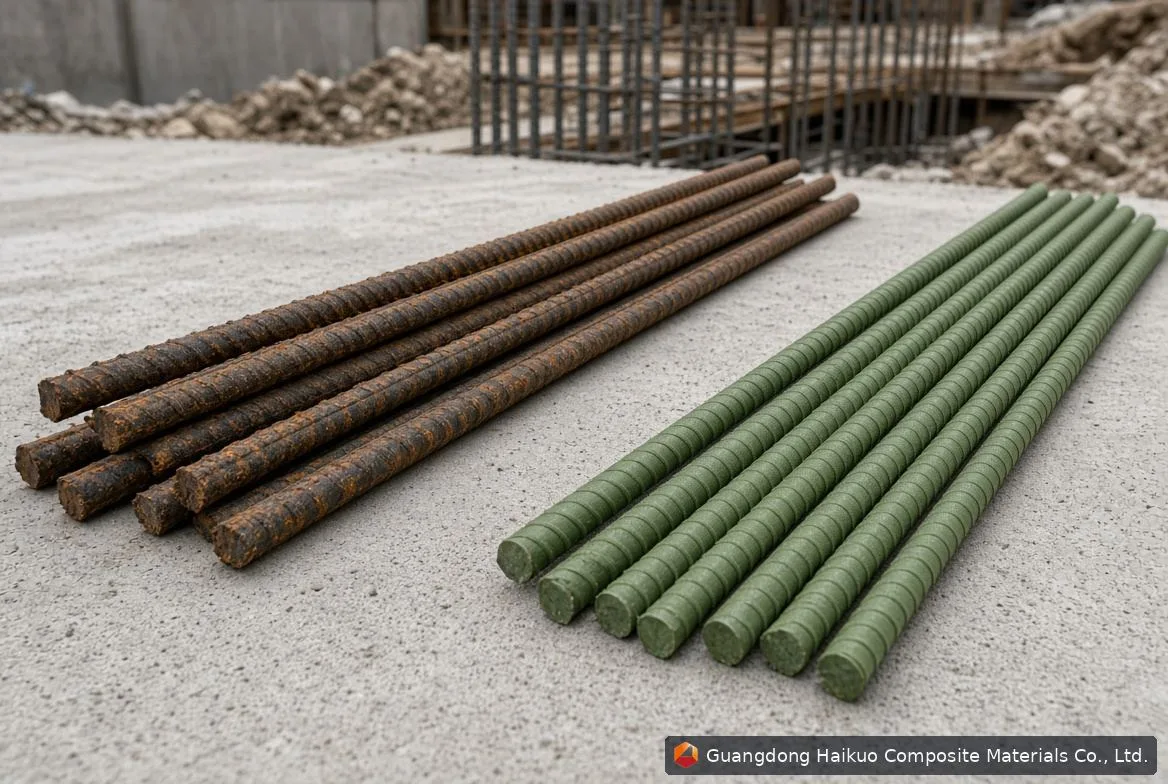
| 4. Surface for bond | A helical wrap and/or sand coating gives a rough surface that bonds with concrete | Poor bond if the wrap or coating is uneven |
| 5. Cure | Heat cures the resin as the bar moves; speed and temperature are balanced | Under-cure lowers strength and durability |
| 6. Pull and cut | A puller moves the bar; a saw cuts to length or the bar is coiled | Damage at the puller; wrong lengths |
Quality checks (common tests)
- Tensile strength and modulus of the bar (for example ASTM D7205);
- Glass content by burn-off and degree of cure by thermal analysis;
- Bond strength to concrete and transverse shear;
- Dimensions (nominal and measured diameter) against the product specification such as ASTM D7957;
- Batch traceability so a lot can be tracked back to its raw materials.
Ask your supplier for the test report of the batch you are buying and compare it with the standard named in the project. How GFRP compares with steel: GFRP vs steel rebar. The general process is explained in the pultrusion process, and the reinforcement layers in rovings, mat and veils.
Why the process matters to the buyer
- Consistent line speed and cure keep strength and diameter within the specification from the first metre to the last.
- The surface treatment (helical wrap or sand coating) decides bond with concrete, so a bond test is as important as a tensile test.
- Batch records let you trace a bar to its raw materials if a problem appears on site.
Send us your requirement
Guangdong Haikuo Composite Materials Co., Ltd. (Huizhou, Guangdong) designs pultrusion moulds in-house and produces custom FRP profiles. Send a drawing, a sample or just the application and the environment, and we will tell you what is feasible.
Email: [email protected] | WhatsApp: +86 189 5198 8522