















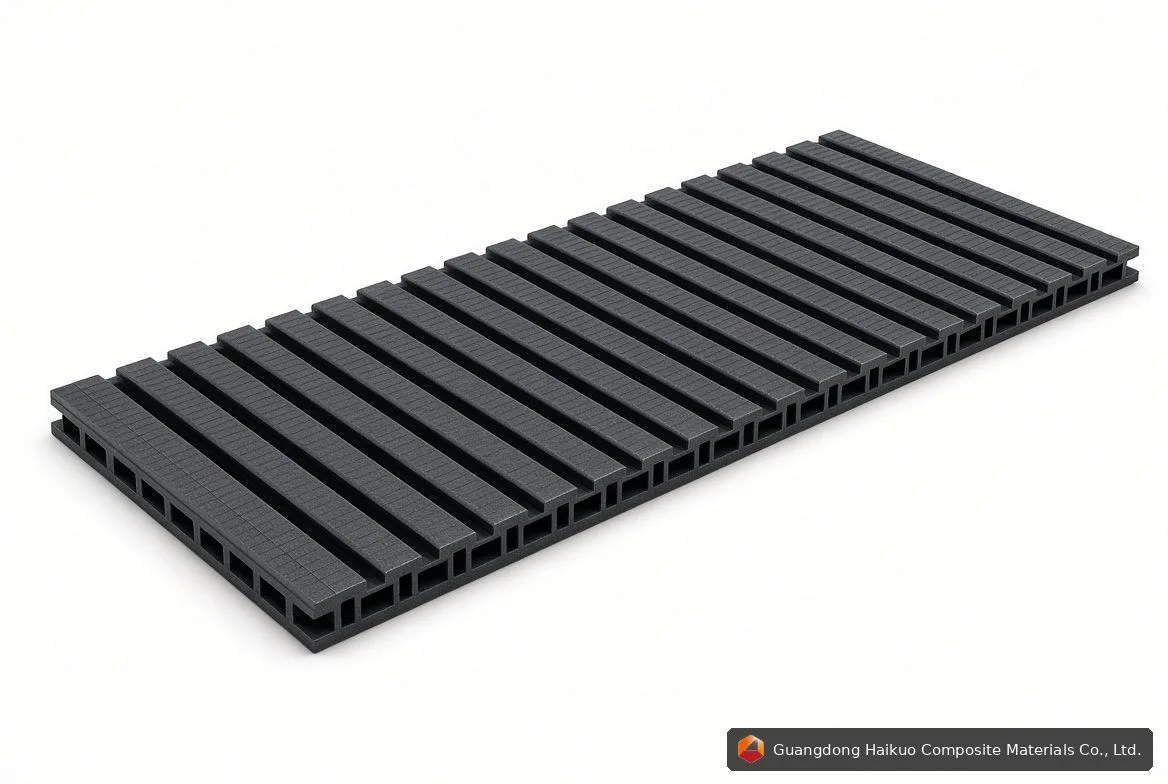
Molded or pultruded?
| Molded grating | Pultruded grating | |
|---|---|---|
| How it is made | Glass rovings and mat laid in a mould and cured | I- or T-bars pultruded, then assembled with cross rods |
| Bar pattern | Square mesh, bars in both directions | Load-bearing bars one way, cross rods the other |
| Load and span | Moderate; shorter spans | Higher stiffness; longer spans |
| Typical use | Trench covers, sumps, cooling towers, chemical areas | Platforms, walkways, higher traffic |
| Cost | Usually lower | Usually higher |
What you must define
- Loads: uniform load (kN/m²), concentrated load (kN), and the deflection limit (L/200 is common; follow your project code).
- Span: clear span between supports and bearing length. Deflection grows fast with span.
- Depth and mesh: grating depth (common molded depths are about 25–50 mm), mesh size and open area.
- Resin: from the chemicals and temperature: see the resin guide.
- Surface: grit-embedded for wet or oily areas, plain or concave for dry areas; the right surface matters more for safety than the panel strength.
- Fire and smoke: state the standard and class if one applies.
Estimating deflection
Grating behaves like many small beams. For a panel on two supports under a uniform load w per unit length of a bar, deflection δ = 5·w·L⁴ / (384·E·I), so doubling the span multiplies deflection by about 16. This is why span is the first thing to fix. Use the supplier’s test-based table for the real value, because bar geometry and fibre content differ between products.
Where it is used
- Walkways, platforms and mezzanines in chemical, water and food plants;
- stair treads and ladder rungs with slip-resistant noses;
- trench and sump covers, flooring in washdown areas;
- offshore and coastal platforms where weight and corrosion matter.
Fibreglass or steel grating?
| FRP grating | Steel grating | |
|---|---|---|
| Corrosion | No rust; resin-dependent chemical resistance | Galvanised or coated; recoating needed |
| Weight | Light, easy to cut and place | Heavy |
| Electrical | Non-conductive | Conductive |
| Span | Shorter for the same load | Longer |
| Fire | Flame-retardant versions needed for rated areas | Non-combustible |
| First cost | Usually higher | Usually lower |
Buying and quoting: buying FRP grating. Grating is also used for decks: FRP decking.
Frequently asked questions
What does FRP grating stand for?
FRP is fibre-reinforced plastic; GRP (glass-reinforced plastic) is the same family. Always name the resin and the fibre.
Can FRP grating be cut on site?
Yes with carbide or diamond tools; seal the cut edges with resin to protect the glass fibres, and wear dust protection.
Send us your requirement
Guangdong Haikuo Composite Materials Co., Ltd. (Huizhou, Guangdong) designs pultrusion moulds in-house and produces custom FRP profiles. Send a drawing, a sample or just the application and the environment, and we will tell you what is feasible.
Email: [email protected] | WhatsApp: +86 189 5198 8522