















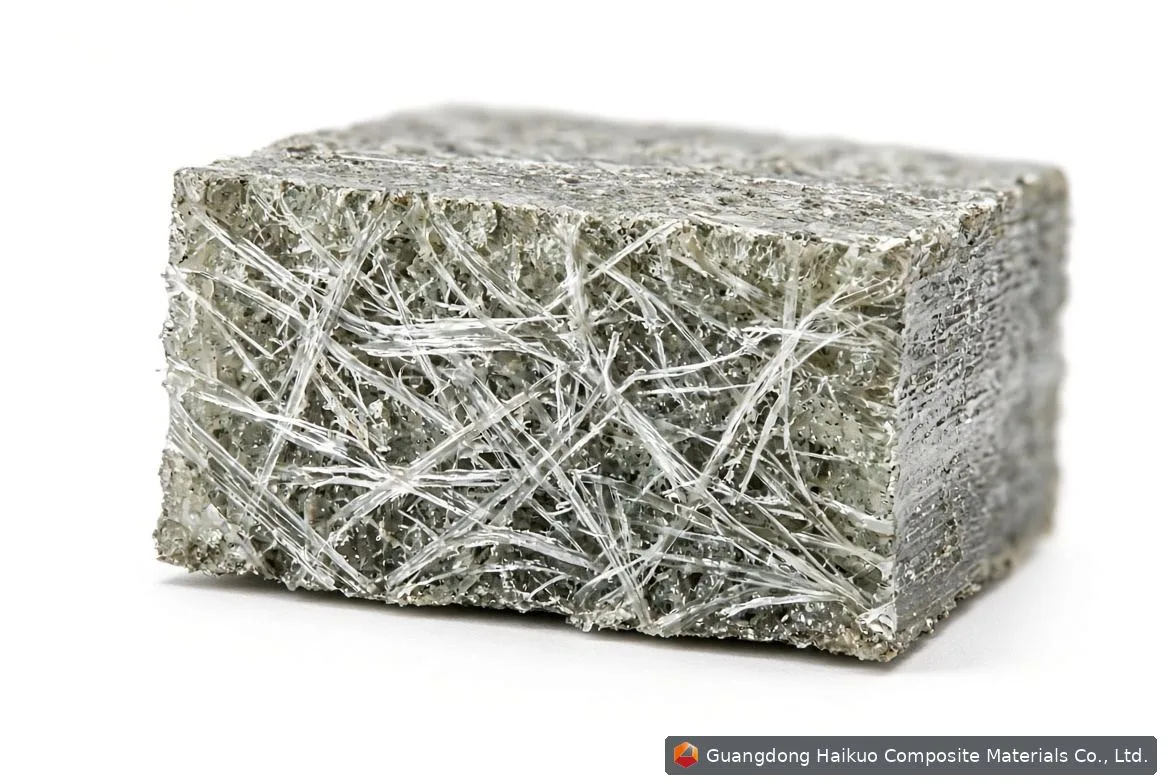
Short answer. FRP (fibre-reinforced plastic, also called GRP when the fibre is glass) is glass or other fibre set in a plastic resin. The fibres carry the load; the resin protects them and holds the shape. It is light, corrosion-proof and non-conductive, but less stiff than steel and its properties depend on direction and on the resin chosen.
What it is made of
| Component | Role | Common choices |
|---|---|---|
| Fibre | Carries tensile and bending load | E-glass (standard), S-glass, carbon, basalt |
| Resin matrix | Binds fibres, transfers load, sets chemical, heat and fire behaviour | Polyester, vinyl ester, epoxy, phenolic (see the resin guide) |
| Fillers and additives | Fire retardancy, UV protection, colour, shrinkage control | ATH, UV stabilisers, pigments |
| Surface layer | Resin-rich skin against UV and chemicals | Surface veil, gelcoat |
How the shape is made
The process decides what shapes are possible, so it is part of the material choice:
| Process | Best for | Not for |
|---|---|---|
| Pultrusion | Straight, constant-section profiles in volume (rods, tubes, beams, gratings) | Sections that change along the length. Large-radius curved profiles need a special curved-pultrusion process. See how pultrusion works. |
| Hand lay-up and spray-up | Large, low-volume parts such as tanks and housings | Tight tolerances and very high fibre content |
| Filament winding | Pipes, vessels and tanks | Flat or irregular shapes |
| Resin transfer moulding / infusion | Complex shapes with a good finish on both sides | Very large series at lowest cost |
Properties and the caveats that go with them
| Property | What you get | Caveat |
|---|---|---|
| Strength-to-weight | High; density is about a quarter of steel | Much lower stiffness than steel: designs are often deflection-controlled |
| Corrosion | Does not rust; chemical resistance set by the resin | Wrong resin for the chemical means premature failure |
| Electrical | Non-conductive | Moisture and surface contamination reduce insulation |
| Dimensional stability | Low thermal expansion in the fibre direction | Properties vary with direction (anisotropic) |
| Failure mode | Predictable at the design stage | Brittle: it does not yield; creep under sustained load |
| End of life | Long service life | Thermoset resins are difficult to recycle; check local options |
How to read an FRP datasheet
- Resin and fibre: which resin family, and which glass (E-glass is standard); glass content by weight.
- Direction: values along the fibres (longitudinal) are much higher than across them; check which one the table quotes.
- Test standards: tensile (ASTM D638), flexural (ASTM D790), compressive (ASTM D695), density (ASTM D792); for profiles also EN 13706.
- Heat: heat distortion temperature of the resin and the maximum service temperature.
- Fire: the standard and class (for example ASTM E84), not just "flame retardant".
When FRP is the right choice – and when it is not
- Good fit: corrosive, wet or coastal sites; electrical safety; hand-installed lightweight structures; non-magnetic equipment.
- Poor fit: very stiff or long-span primary structure, high continuous temperature without a suitable resin, and applications needing ductile failure.
Frequently asked questions
Is FRP the same as GRP?
In practice yes: GRP (glass-reinforced plastic) is FRP with glass fibre, and the term is common in some regions.
Is FRP fireproof?
No. Standard resins burn. Flame-retardant and phenolic systems exist for fire-rated use; the required standard and class should be named at the quote stage.
How do I choose a profile?
Start with the environment and the load, then see the profile range or send us your drawing.
Send us your requirement
Guangdong Haikuo Composite Materials Co., Ltd. (Huizhou, Guangdong) designs pultrusion moulds in-house and produces custom FRP profiles. Send a drawing, a sample or just the application and the environment, and we will tell you what is feasible.
Email: [email protected] | WhatsApp: +86 189 5198 8522