















In bending, the material near the surface does most of the work, so the centre of a solid rod contributes little. The numbers below are idealised and calculated for a 10 mm outer diameter, assuming the same fibre and resin and a uniform section; stiffness is proportional to the second moment of area I = π(D4 − d4)/64 and mass to the cross-section area.
| Hollow tube, 10 mm OD, inner diameter | Bending stiffness vs solid rod | Mass vs solid rod |
|---|---|---|
| 4 mm (3.0 mm wall) | 97 % | 84 % |
| 5 mm (2.5 mm wall) | 94 % | 75 % |
| 6 mm (2.0 mm wall) | 87 % | 64 % |
| 7 mm (1.5 mm wall) | 76 % | 51 % |
| 8 mm (1.0 mm wall) | 59 % | 36 % |
For example, a 10 mm tube with a 6 mm bore keeps about 87 % of the stiffness at 64 % of the mass. Thinning the wall further saves weight quickly but costs stiffness, and thin walls are where crushing and local buckling start.
Decision guide
| Situation | Better choice | Why |
|---|---|---|
| Part is struck, clamped, stepped on or crushed | Solid | No wall to collapse; the whole section resists point loads. |
| Holes, threads or pins are cut into the part | Solid | Machining a thin wall can crack or collapse it. |
| Long span in bending (poles, cross-arms, tent poles) | Hollow | Stiffness per kilogram is higher; lower handling and shipping weight. |
| Wires, sensors or fluid must run inside | Hollow | The bore is the feature. |
| Small diameters (very thin wall would be needed) | Solid | A thin hollow wall at small OD is fragile and hard to make consistently. |
| Marine or wet outdoor use | Either | Seal hollow ends so water cannot collect inside; solid rod has no cavity to protect. |
Three questions to settle it
- Is the main load bending or point impact? Bending favours hollow; impact and crushing favour solid.
- Does weight cost you money? Hand-carried or telescoping parts and long-distance shipping reward hollow sections.
- Will anyone machine or fasten it? If yes, solid, or a tube with a wall thick enough for the fastener.
Frequently asked questions
Will a hollow tube break more easily than a solid rod?
Not if the wall is sized correctly. A tube with a larger diameter can out-bend a thinner solid rod and still weigh less. It is weaker against crushing and sharp point loads.
Can a solid fiberglass rod be used as an electrical insulator?
Yes, fibreglass is non-conductive, but the resin, any moisture and the surface condition determine the actual insulation performance. State the voltage and environment when you ask for a quote.
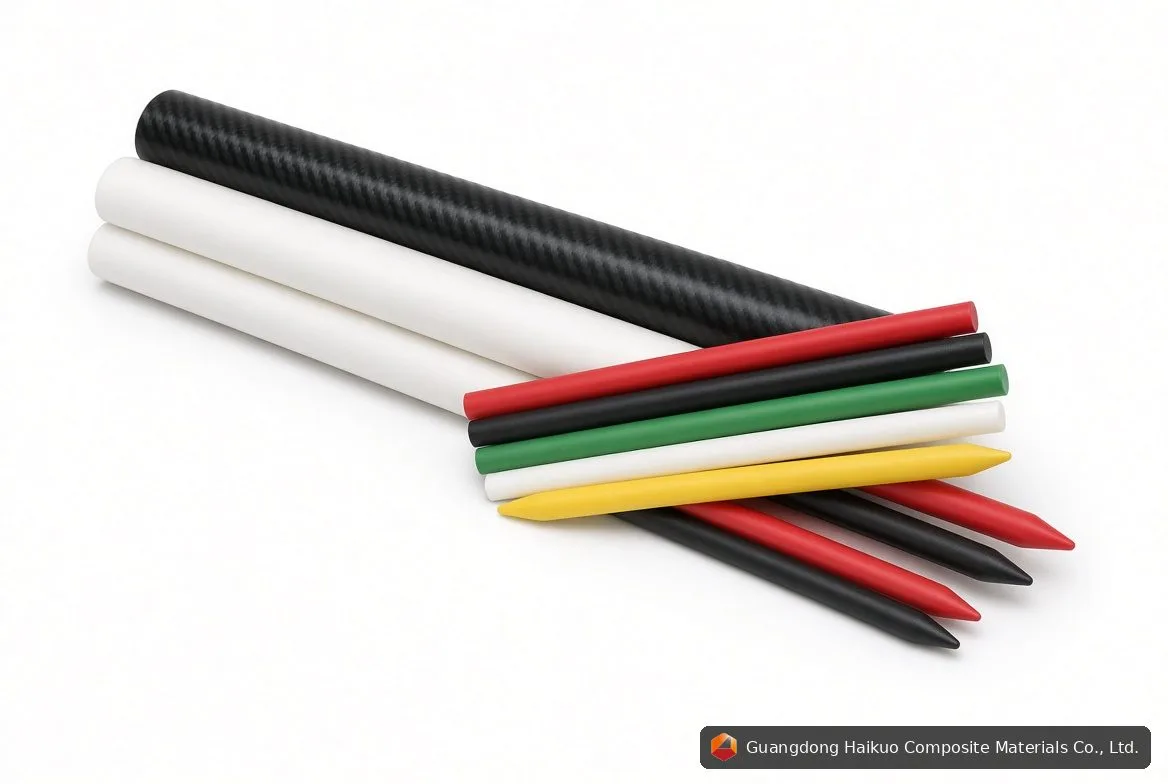
See our fiberglass rods and fiberglass tubes.
Send us your requirement
Guangdong Haikuo Composite Materials Co., Ltd. (Huizhou, Guangdong) designs pultrusion moulds in-house and produces custom FRP profiles. Send a drawing, a sample or just the application and the environment, and we will tell you what is feasible.
Email: [email protected] | WhatsApp: +86 189 5198 8522